
Uncategorized
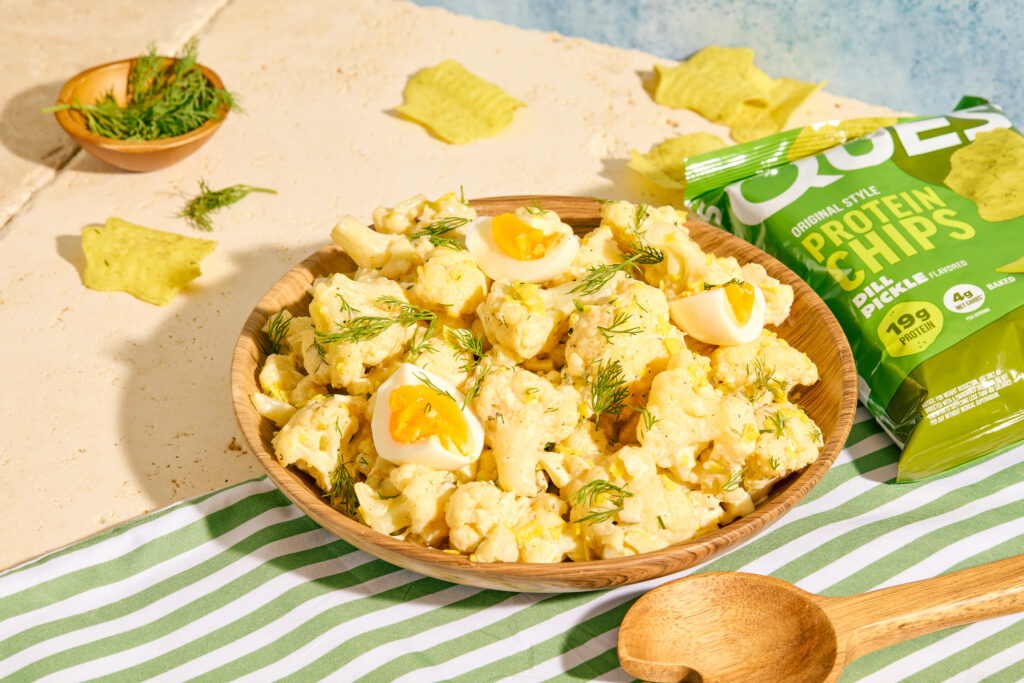
Quest Cauliflower Dill Pickle “Potato” Salad

Quest Cauliflower Dill Pickle “Potato” Salad

The classic picnic side just took a crispy, pickle-packed turn. And it’s dressed for the occasion. Steamed cauliflower gets tossed with creamy mayo, Dijon mustard, hard-boiled eggs, celery, fresh dill, and plenty of chopped pickles before Quest Dill Pickle Chips bring the bold flavor and crispy finish. It’s creamy, tangy, savory, and seriously satisfying. This side dish brings plenty to the table. Chill, serve, and watch it disappear.
Check out the full recipe below:
NUTRITIONAL INFO
CAULIFLOWER “POTATO” SALAD
Yields: 5 servings | Serving Size: 1/5 recipe
Calories: 270 | Protein: 9g | Fat: 20g | Net Carb: 6g
Total Carb: 8g | Sugar: 3g
Ingredients
CAULIFLOWER “POTATO” SALAD
- 24oz cauliflower florets, steamed and cooled
- ½ cup mayonnaise
- 2 tbsp dijon mustard
- ½ tsp paprika
- ½ tsp salt
- ¼ tsp ground pepper
- 3 tbsp chopped dill pickles
- 3 hard boiled eggs, diced
- 2 tbsp celery, finely chopped
- 1 tbsp fresh dill, chopped
- 1 bag Quest Dill Pickle Chips, crushed
Method
- Add the cauliflower to a large mixing bowl.
- Mix in the mayonnaise, mustard, paprika, salt and pepper.
- Once the cauliflower is evenly coated, mix in the remaining ingredients.
- Chill and serve.
A Simple Protein Swap for Healthy Aging
Swapping just 1% of plant protein in place of animal protein was associated with significantly less age-related deficit accumulation.
Based on a study of more than 400,000 people, replacing just 3% of calories of animal protein with plant protein was associated with a 10% reduction in overall mortality risk. That simple swap could translate to about an extra year of life. Egg protein—mostly found in egg whites—appeared to be the biggest offender when it came to mortality risk. Swapping 3% of calories from egg protein for plant protein was associated with more than a 20% reduction in overall mortality—greater than the reduction seen when replacing red meat with plant protein. However, it’s not just about adding years to your life, but life to your years. How do changes in dietary intake of animal versus vegetable protein affect unhealthy aging?
Healthy aging is defined as “the process of developing and maintaining the functional ability that enables wellbeing in older age.” No one wants to be vegetative, and you may be able to avoid that by eating more vegetables. A higher intake of vegetable protein was associated with less accumulation of deficits, based on functional impairments, mental health and diseases, self-reported health and vitality, and the use of health services.
Swapping in just 1% of vegetable protein calories for animal protein “led to significantly less deficit accumulation.” Don’t animal protein and animal fat travel alongside each other in the same foods? Is this just a saturated fat effect? No—even after accounting for fat, there still seemed to be something about whether the protein came from animal or plant sources, but it’s still not clear whether the beneficial health effects are due to avoiding the deleterious effects associated with animal foods or from the beneficial effects of plants, though it may be a bit of both.
A recent review in a dermatology journal on the role of a whole food, plant-based diet in preventing and reversing skin aging emphasized this point. A whole food, plant-based diet is not the same as a vegan diet. It’s possible to have a terribly unhealthy vegan diet, filled with sugar, processed oils, and white flour and no fresh fruits or vegetables. As a physician, “vegan” just tells me what a person doesn’t eat, but they actually have to, you know, eat vegetables, too. And when they do, “a whole food, plant-based (WFPB) diet can aid in the prevention, and in some cases reversal, of some of the leading chronic diseases in the United States,” as well as potentially contributing to younger-looking skin, due to telomere lengthening, maximizing our cells’ antioxidant potential, and eliminating harmful carcinogens and aging toxins, known as gerontotoxins, from entering our bloodstream.
It is no wonder “the highest life expectancy of any formally described population” in the world may be the Adventist vegetarians in Loma Linda, California, one of the world’s five original “blue zones.” The average life expectancy of Adventist vegetarian men and women is about 83 and 86 years, respectively, about 10 and 6 years longer than the general population in California. Those who eat a vegetarian diet with nuts, exercise, have a lower weight, and never smoke live about 9 to 11 years longer than people lacking these habits, as you can see below and at 3:22 in my video The Best Diet for Healthy Aging.
That’s like having 10 years of life up for grabs.
Now, “[s]ubstantial gains in life expectancy would only be worthwhile if they were also accompanied by a longer period of good-quality life.” Although overall well-being has not been measured directly, vegetarian Adventists have been recorded taking fewer medications and logging fewer x-ray examinations, surgical procedures, and overnight hospital stays. Their reduced prevalence of several chronic diseases alone would presumably make life more worth living.
The most feared disease associated with getting older is likely Alzheimer’s disease. Dementia is one of the fastest-growing epidemics, affecting 1 in 10 people older than 65 years of age and half of all people older than 85. Alzheimer’s is the main type of dementia, and indeed the most feared. So, when we’re talking about “plant-based diets for healthy aging,” “[p]articularly intriguing is emerging evidence that diet plays a major role in the prevention of age-related cognitive decline and Alzheimer’s disease. It has been shown that a diet rich in fruits, grains, legumes [beans], vegetables, nuts, and seeds may cut the risk of Alzheimer’s disease by more than a half.”
This evidence comes from research on the “MIND diet,” which emphasizes natural plant foods, specifically including berries (the healthiest fruits) and greens (the healthiest vegetables), while limiting the intake of animal foods and high saturated fat foods like meat and dairy.
Strictly adhering to the MIND diet was associated with a 53% reduction in risk for Alzheimer’s disease. In fact, even moderate adherence appeared to cut risk by about a third. Overall, participants with high adherence to the diet had the cognitive function equivalent to someone 7.5 years younger.
No wonder people who ate meat, including poultry and fish, “were more than twice as likely to become demented as their vegetarian counterparts”—and that rises to three times the risk when taking past meat consumption into account. This may be because “[p]lant-based diets are known to preserve body tissues from oxidative stress and inflammation, both hallmarks of chronic-degenerative diseases.” That may be why berries are so protective, since they’re so rich in antioxidants, and in terms of inflammation, those who avoid meat have a higher abundance of anti-inflammatory compounds flowing through their systems and lower levels of proinflammatory indicators like C-reactive protein. “Dietary factors also influence the effect of stress on cognitive decline. Diets characterized by high intake of animal proteins, saturated fats, and refined sugar along with low intake of plant-based foods can increase secretion of corticosteroids,” stress hormones like cortisol from the adrenal glands, which may promote the development of Alzheimer’s disease.
Then there are the gerontotoxins, like AGEs (advanced glycation end products), in our diet that may be a factor in the development of Alzheimer’s. Safe foods—foods that have low AGE content—include starches like whole grains, beans, fruits, and vegetables, whereas the main dietary sources of AGEs are broiled, grilled, fried, or roasted meats. The cooking process is important. Chicken breast has an AGE level of 1,000 KU when boiled in water (for chicken soup, for example), but that same chicken breast jumps up to 9,000 KU when broiled. Below and at 6:53 in my video is a list of the top 40 most AGE-contaminated foods tested, in terms of AGEs per serving.
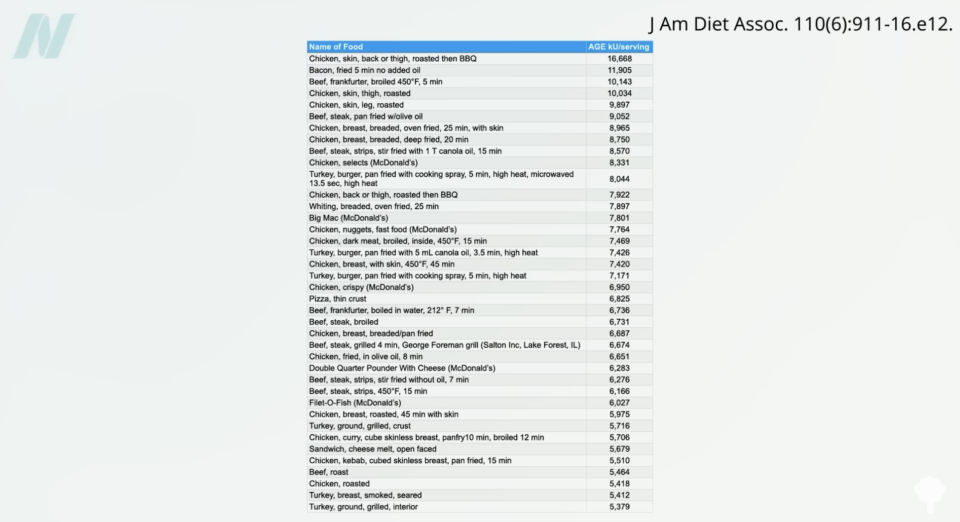
As you can see, it’s almost all meat: chicken, bacon, hot dogs, and so on. I tell people to choose raw nuts and seeds to avoid AGEs, but even roasted, toasted nuts don’t come close to making the list.
Now, of course, diet is not the only factor when it comes to reducing the risk of cognitive decline. We also need to get adequate sleep, rest, and physical activity. For example, daily brisk walks were associated with a 40% lower risk of developing Alzheimer’s later in life, and smoking may double the risk of developing dementia. But in terms of preventing Alzheimer’s with diet, the key takeaways are the following: reduce added sugars, added salt, saturated fat, animal products, and processed foods in general while eating more plants (especially greens and beans) and fruits (especially berries).
Doctor’s Note
Aging is the topic of my book How Not to Age. Check it out at your local public library.
Some of my popular videos on aging and longevity include:
Uncategorized
How This 53-Year-Old Lost Fat, Built Strength, and Kept It Off (Without Starving) Fat Loss Over 50: How Anthony Lost Weight & Built Strength
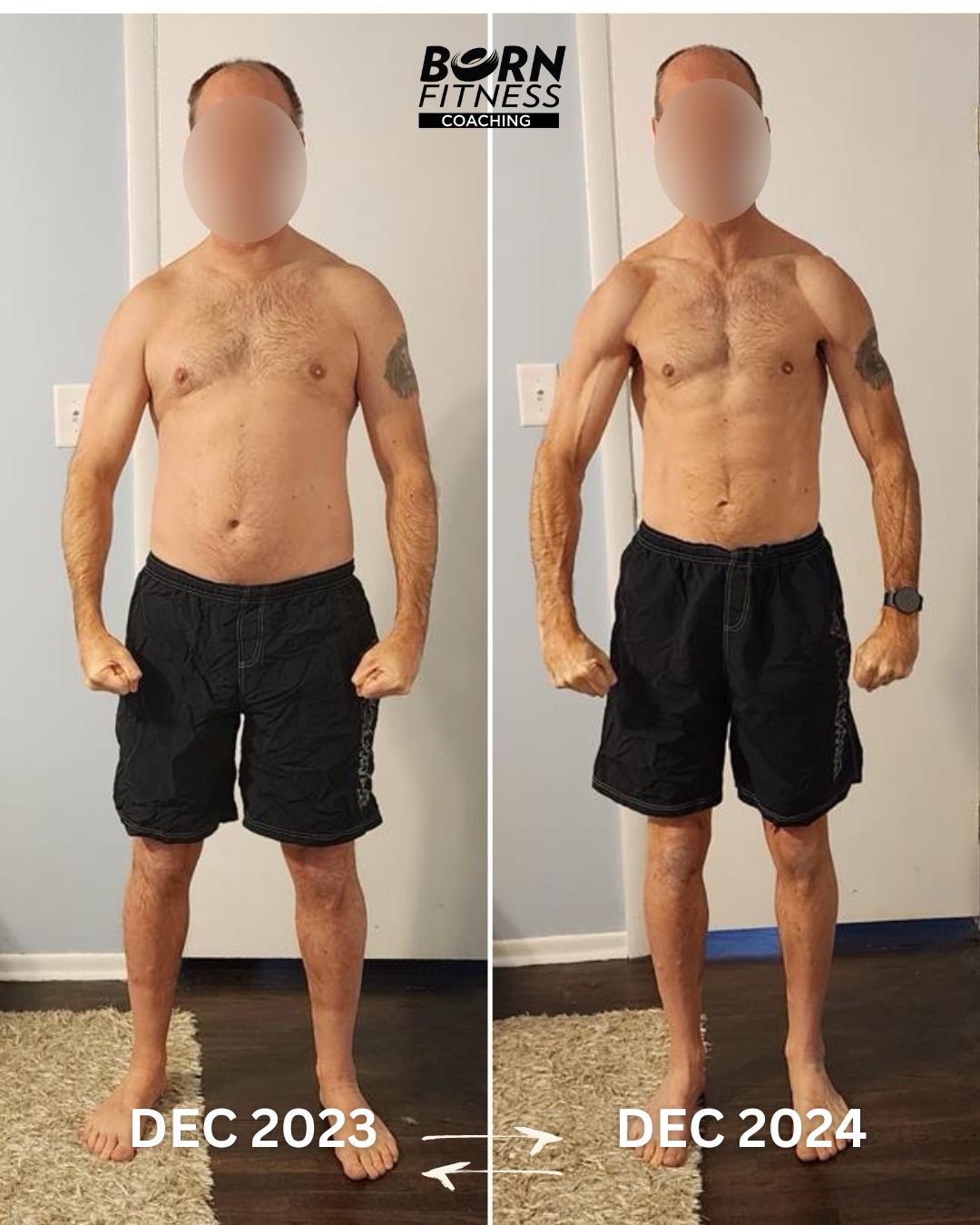
How This 53-Year-Old Lost Fat, Built Strength, and Kept It Off (Without Starving) Fat Loss Over 50: How Anthony Lost Weight & Built Strength
When Anthony, a 53-year-old, told us he wanted to look like Jason Statham, we gave him a plan he didn’t expect:
Three workouts per week.
A moderate calorie deficit.
No complicated macros—just protein and total calories.
Anthony was skeptical. His past weight-loss attempts followed the same frustrating pattern that probably looks familiar if you’re a man looking for fat loss over 50 :
- Drastically cut calories
- See quick results
- Hit a plateau and stall
- Get frustrated and give up
- Regain the weight (plus more)
- Try another extreme diet
This is the cycle that traps so many people. It’s not that crash dieting doesn’t work—it does, but only for a short period of time. Eventually, the extreme restriction leads to burnout, stalled progress, and ultimately, weight regain.
If that sounds familiar, you’re not alone. Many men over 50 get stuck in this cycle. The problem isn’t that they’re not trying—it’s that the approach itself is flawed.
Why Crash Dieting Fails (Especially Over 50)
Extreme calorie cuts can deliver short-term results, but they come at a cost:
- Muscle loss – The more muscle you lose, the slower your metabolism becomes.
- Increased hunger – Your body fights back, making it harder to stick to the plan.
- Low energy and poor recovery – You feel drained, making workouts (and daily life) miserable.
- Metabolic slowdown – Over time, your body adapts, making it even harder to lose weight.
That’s why Anthony needed a new strategy—one built for sustainability.
How Anthony Finally Lost Weight (And Kept It Off)
Instead of another crash diet, Anthony followed a sustainable fat-loss strategy designed for long-term success.
1. Strength Training: 3 Full-Body Workouts Per Week
Forget the idea that you need to train 5 or 6 days a week to see results. The real question is: Is your plan a good fit for you?
I’ve seen plenty of people burn out trying to train every day. Meanwhile, others achieve incredible transformations with just 3-4 workouts per week. It’s not about more—it’s about consistency and intensity.
The goal isn’t just to show up at the gym—it’s to crush your workouts without draining the rest of your day. You need the energy to push hard, recover well, and come back ready to do it again.
A solid program balances three key factors:
✅ Consistency – If you don’t believe you can stick with it for a year, it’s probably not the right plan.
✅ Intensity – Not every session is a PR, but a mix of steady workouts (5-6/10 intensity) and strong efforts (9-10/10) gets results.
✅ Confidence – You should feel in control of your training, not overwhelmed by it.
2. A Moderate Calorie Deficit (No Starving)
The foundation of fat loss is burning more calories than you consume—but that doesn’t mean extreme restriction.
Anthony’s approach focused on:
- A realistic calorie deficit – 250-500 calories per day, not drastic cuts.
- More movement – Prioritizing daily steps instead of endless cardio.
- Eating enough to fuel workouts – So he could build muscle, not lose it.
The result? Avoiding burnout from excessive dieting or training. A moderate deficit allows progress without extreme hunger or exhaustion.
3. Protein + Total Calories (Without Overcomplicating Macros)
You don’t need to meticulously track every macro for fat loss after 50. In fact, obsessing over hitting exact numbers—like debating whether you need 7 almonds or 14—can lead to unnecessary stress (and even disordered eating).
Instead, focus on two simple targets:
Protein – Prioritize lean protein sources to support muscle and recovery.
Total Calories – Stay within your range without micromanaging every gram of fat or carbs.
Does this mean tracking macros is bad? Not at all. It can be useful, but for most people—especially beginners—a simplified approach leads to better long-term success.
Bonus: Don’t Forget Fiber
Food quality still matters. Could you lose weight eating junk food? Technically, yes. But you won’t feel great doing it.
That’s why we focus on whole foods and fiber intake to improve digestion, satiety, and overall health.
Daily Fiber Goals:
- 25 grams per day for women
- 35 grams per day for men
The Results: A Year of Real, Sustainable Fat Loss
After 12 months, Anthony didn’t just lose weight—he got stronger, leaner, and broke free from the yo-yo dieting cycle.
More importantly, he now has the tools to keep the weight off permanently—without starving himself or spending hours in the gym.
What You Can Learn From Anthony’s Transformation
Why did it work?
Because consistency beats complexity.
The secret isn’t extreme diets or brutal workouts—it’s building habits that stick.
When you stop rushing the process, the results take care of themselves.
Ready to break the cycle and build a plan that actually works? Get expert coaching, a customized strategy, and the support you need to make real progress—without extreme diets or exhausting workouts.
👉 Apply for coaching today and take the first step toward lasting results.

B.J. holds a B.S. in Health and Human Performance and multiple certifications, including Precision Nutrition Level 1 and BioForce Certified Conditioning Coach. Over his 14-year coaching career, he’s been fortunate enough to coach a wide range of clients. From online clients looking to get in great shape to CEO Nate Checketts (Rhone) and CEO Marcelo Claure (Softbank), and professional skateboarder Sean Malto. Before beginning his training career, he was a sports science lab research assistant.
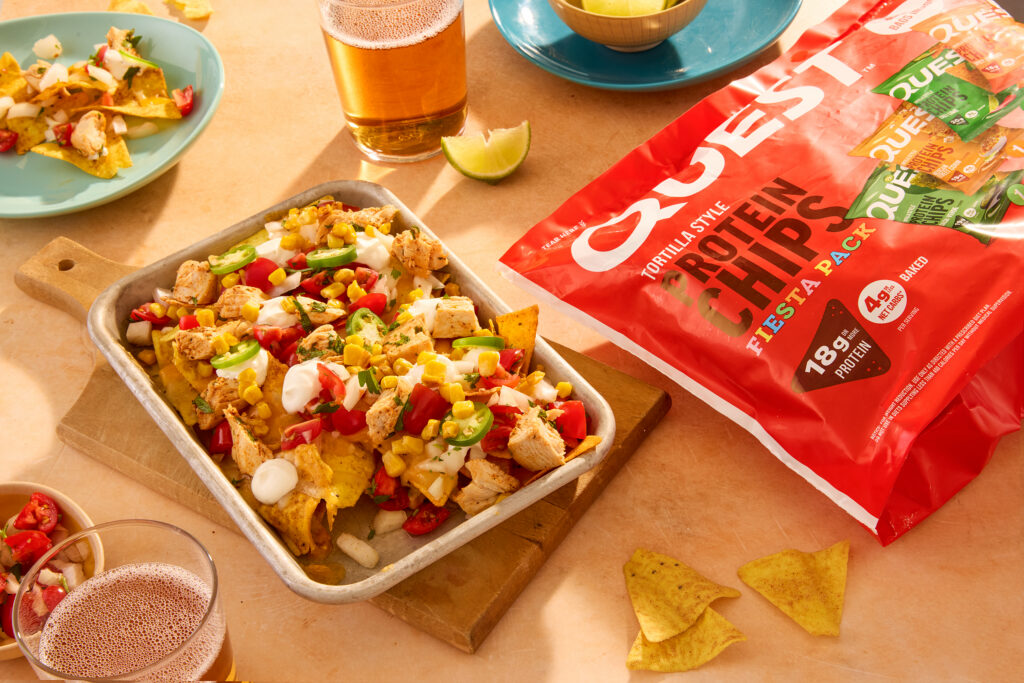
Quest Fiesta Pack Chicken Nachos Recipe
Since the dawn of nachos, brave warriors of the kitchen have ceaselessly endeavored to make nachos even more extra. First came cheese. Then jalapeños. Then meat. What could possibly come next? Four different chip flavors, obviously. Questified Fiesta Pack Chicken Nachos bring Spicy Queso, Chili Lime, Mexican Street Corn and Salsa Verde Flavor Protein Chips to the party, along with seasoned chicken, cheddar, corn, jalapeños, tomatoes, onion and cilantro. Because as any true nacho-lover will tell you, more is always better.
Check out the full recipe below:
NUTRITIONAL INFO
FIESTA PACK CHICKEN NACHOS
Yields: 4 servings | Serving Size: 1/4 nachos
Calories: 350 | Protein: 42g | Fat: 16g | Net Carb: 8g
Total Carb: 10g | Sugar: 4g
Ingredients
FIESTA PACK CHICKEN NACHOS
- ½ tbsp olive oil
- ½ lbs chicken breast
- Salt and pepper
- 1 tbsp chicken dry rub seasoning
- Juice from ¼ lime
- 1 Quest Fiesta Pack Tortilla Chips (4 Individual bags)
- ½ cup grated cheddar cheese
- ¼ cup cilantro, separated
- ½ cup chopped cherry tomatoes
- ¼ cup chopped yellow onion
- ¼ cup grilled corn kernels
- 1 small jalapeno, sliced
- ¼ cup sour cream
Method
- Pat the chicken dry and slice lengthwise to make two thinner pieces of chicken. Sprinkle with salt and pepper.
- Heat the oil in a skillet over medium heat. Add the chicken breast and cook for 4-5 minutes on each side
- Once cooked, remove from heat and let rest for 5 minutes.
- In the meantime, add the dry rub, lime juice and ½ of the cilantro to a bowl.
- Cut the chicken breast in ½ inch pieces and toss with spice mixture until well coated.
- Assemble the nachos by spreading half of the chips in an even layer on a baking sheet, top with half of the cheese and chicken.
- Top with remaining chips, cheese and chicken. Place the nachos into a 350F oven for 5 minutes and the cheese has melted.
- Top with remaining ingredients and serve immediately.
-
 HEALTH & WELLNESS8 years ago
Acidophilus: A Probiotic Bacterium
-

 herbs3 years ago
The Ultimate Guide to Ashwagandha Extract: Stress Relief and Optimal Health Unveiled
-
 HEALTH & WELLNESS7 years ago
Herbs and Essential Oils to Fight Coronavirus
-
 TRAINING & FITNESS8 years ago
6 Ways to Decrease your Shoulder Pain!
-
 Fitness8 years ago
“No Pain, No Gain” True or Just a Fitness Myth
-
 HEALTH & WELLNESS8 years ago
Why Muscles Get Sore
-
 DIET & NUTRITION8 years ago
Low Carb Diet: Carbohydrates Influence on Testosterone
-
 TRAINING & FITNESS7 years ago
Training to Failure Every Set… Pathway to New Muscle or Pathway to Overtraining?