
Uncategorized
Is Bone Density Linked to Diet? It May Come Down to Body Size

Is Bone Density Linked to Diet? It May Come Down to Body Size

Those eating a plant-based diet tend to be so much slimmer that their bone mass may suffer.
Osteoporosis affects an estimated 200 million people worldwide. Translating to “porous bone,” osteoporosis is a disease characterized by excessive bone loss, reduced bone formation, or a combination of both, which can weaken bones and increase the risk of fractures. “Bone mineral density (BMD) is the most robust and consistent predictor of osteoporotic fracture.” What can we eat to boost our bone density? Well, we know that increased consumption of plant foods is associated with increased bone mineral density.
There’s an “extensive range of micronutrients and phytochemicals packaged within plants” that can be powerful promoters of bone health, so “healthcare professionals should be encouraged to advise the increased consumption of plant based foods, particularly in mid-life, irrespective of the clients’ underlying dietary pattern”—meaning no matter how much meat or junk is eaten, adding more healthy plant foods may help prevent the development of osteoporosis. On the other hand, a more “animal-sourced nutrient pattern” has been associated with a higher risk of fractures, suggesting that a more animal-based diet is related to bone fragility. So, one would expect less osteoporosis in those eating plant-based diets, but you don’t know until you put it to the test.
The first study, “Incidence of Osteoporosis in Vegetarians and Omnivores,” was published nearly 50 years ago and found that the measured bones were significantly denser in the vegetarians than in the omnivores. In fact, the average bone densities of the vegetarians in their 70s was greater than that of the meat-eaters in their 50s. The bottom line: “These results suggest that there is less likelihood of vegetarians developing osteoporosis in old age.” It turns out, though, that the researchers screwed up. DEXA scanning, which is what we use now, didn’t come online until the 1980s. So, the researchers were using just regular x-rays and confused the readings, giving darker bones on x-rays a higher score, even though darker bones actually indicate “a lesser bone mass than a lighter image.” Their conclusion should have been reversed: The vegetarians had worse bone mineral density.
Fast forward about 40 years, by which time nine studies had been done on thousands of individuals. All in all, “[t]he results suggest that vegetarian diets, particularly vegan diets, are associated with lower [bone mineral density], but the magnitude of the association is clinically insignificant,” meaning the difference was so small as to not really matter out in the real world, reinforcing the fact that “vegetarian diets have no clinically detrimental effect on bone health.”
It’s important to note that the findings of lower bone mineral density didn’t fully control for key confounding factors, such as differences in body weight. We know that people who are obese have stronger bones. Why? Because they’re essentially weight-lifting all day, every day. Walk around with a 100-pound backpack every day, and your bones would grow stronger, too. That’s how to build strong bones: weight-bearing exercise. So, people who weigh more have denser bones. Vegetarians and especially vegans have such low rates of obesity that no wonder, on average, they would have lower bone density. The researchers didn’t take weight into account, but if the difference they found isn’t even clinically significant, who cares? “Is ‘vegetarianism’ a serious risk factor for osteoporotic fracture?” As of 2009, the answer to that question was no. “Vegetarianism is not a serious risk factor.”
By 2018, the latest meta-analysis on veganism, vegetarianism, and bone mineral density included 20 studies, involving tens of thousands of participants. It found lower bone mineral density among vegetarians and vegans compared with meat-eaters. The researchers concluded that vegetarian and vegan diets need to be “appropriately planned” to preserve their bones. But did they account for the obesity factor?
No, they did not. They just used what are called “crude risk ratios”—meaning no adjustments are made for confounding factors like weight—so they didn’t control for things like age, smoking, obesity, or exercise, making the results really “uninterpretable.” But no one had gone through the trouble of going back through all those studies and making the proper adjustments. Then, in 2020, researchers did just that. The title of their study gives away what they found: “Differences in Bone Mineral Density between Adult Vegetarians and Nonvegetarians Become Marginal when Accounting for Differences in Anthropometric [Body Size] Factors.” Yes, bone mineral density values were significantly lower among vegetarians than among nonvegetarians, which is the case with nearly every study on bone mineral density and excess body weight, as you can see below and at 4:58 in my video Do Vegans Have Lower Bone Mineral Density and Higher Risk of Osteoporosis?.
But forget clinical significance—these differences even lost statistical significance after adjusting for body size factors, suggesting that lower bone mass among vegetarians is largely explained by their lower Body Mass Index (BMI) and waist circumference. Thus, it’s not so much the composition of vegetarian and vegan diets as the fact that people who eat them tend to be much slimmer.
Now, a small yet statistically significant difference remained for total lower spine density, a difference of 0.03 g/cm2. This was dismissed as having little clinical relevance, but is that true? If the reproducibility of bone mineral density measurements in daily medical practice is considered, repeated tests performed back to back show some scatter in the measurements, as you can see at 5:44 in my video.
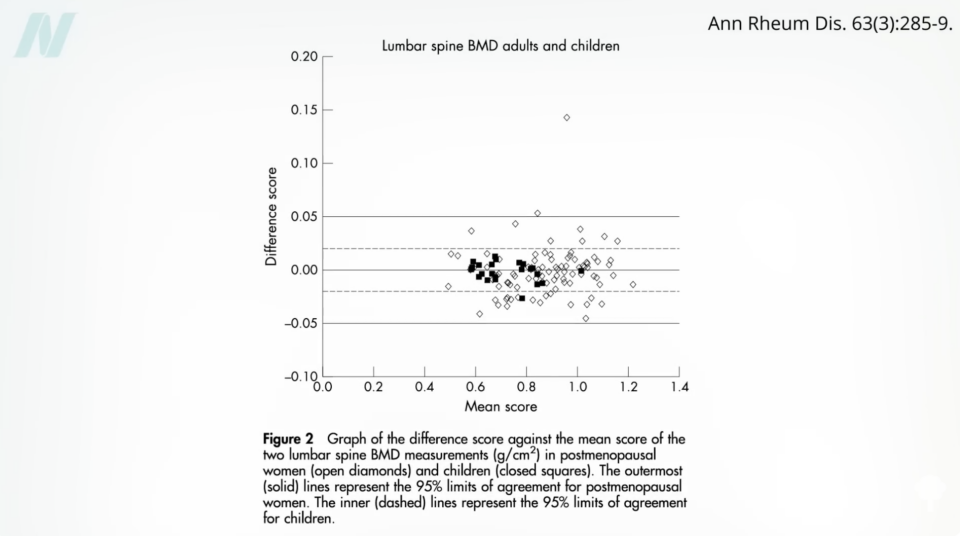
So, a significant difference really has to be more than the inherent variation. Indeed, expressed as the smallest detectable difference, a bone mineral density disparity of at least 0.05 g/cm2 at the spine is needed before it can be considered a significant change, so there does appear to be little clinical relevance. However, even if vegetarians and vegans basically have the same bone density at the same weight, everyone who is skinny is at risk. Low BMI is a risk factor for fractures; so, “all persons in a low body weight category consuming any kind of diet should be monitored for osteoporosis.”
Doctor’s Note
Stay tuned for more on actual bone fracture rates. In this blog, I’m just setting the stage.
In the meantime, check out some of my other videos on bone health:


How to Prevent Holiday Weight Gain Without Dieting
Every year, headlines warn that we gain 5–10 pounds during the holidays.
But research tells a different story: most people gain just 1–3 pounds between November and December.
In the grand scheme of things, it’s not a big deal. And anyone who’s followed us for a while knows we support eating and enjoying the holidays.
But there’s one important catch: Eating without guilt or shame during the holidays is much different from eating without boundaries for the entire holiday season.
The Real Numbers Behind Holiday Weight Gain
Here’s what makes that “1 to 3 pounds” stat so interesting — and why it deserves your attention.
On average, people gain 1 to 3 pounds per year from their twenties into their forties. Just look at this graph from the CDC.
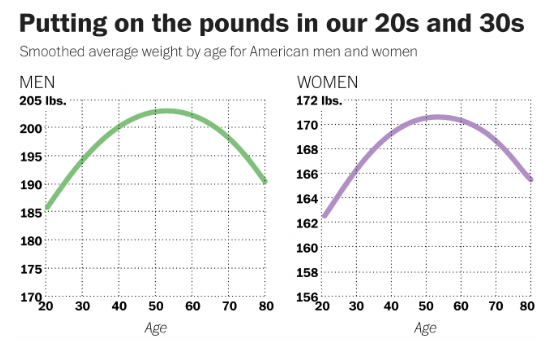
If you look at the CDC data above, you’ll see that the weight gain isn’t usually a big jump. It’s a slow process of a couple of pounds per year.
It feels like a rounding error when you gain one pound in a year. But gaining one pound per year for 20 years can make you look and feel like a different person.
Weight gain also appears to have a critical threshold where risks start to rise.
According to research from Harvard:
- Every 11 pounds gained is associated with a 30% higher risk of type 2 diabetes.
- A 14% higher risk of high blood pressure.
- A 6% higher risk of obesity-related cancers.
- And a 5% higher risk of premature death (among nonsmokers).
This isn’t about fear. It’s about clarity.
The easiest way to think about weight maintenance is this:
If you’re not steadily gaining weight, there’s far less urgency to lose it.
But to stop gaining weight over the long run, you need to understand when the weight tends to accumulate.
And that brings us to a critical window most people overlook.
The Critical Window: The 7 Weeks That Shape Your Year
If you look closely at the data, weight gain tends to happen at one specific time of year: the holidays.
You might go up a few pounds in one month and down a few in others, but for many people, the steady upward trend starts with November and December.
And the research backs this up:
NIH-funded studies show that the average one-pound holiday gain sticks, accumulates, and compounds over time.
Those small increases are often never fully lost, and they become the starting point for the next year’s increase.
So when you think of “holiday weight gain,” don’t picture a catastrophic 10-pound spike.
Picture something far more subtle — but far more persistent.
A one-pound carryover every year becomes a lifelong trend.
That’s why learning how to master the last seven weeks of the year can be so powerful. It’s not about restriction. It’s about preventing the start of a pattern that builds slowly and silently.
The good news?
It’s surprisingly easy to prevent — if you focus on the right habits.
How to Avoid the Holiday Weight Trap
Researchers have looked closely at how to prevent end-of-year weight gain. One study found that daily weigh-ins can help maintain weight through the holidays.
You can do that for two months. It’s doable for many and may be worth the short-term sacrifice if weight gain is a struggle during the holidays.
But for many people, weighing yourself every day creates more stress — and extra stress is the last thing anyone needs in November and December.
The bigger issue isn’t the holidays themselves. It’s how people behave before and after them. The stress, the overthinking, the “I blew it, so why bother” spiral. That’s the real trap.
A simpler, more sustainable approach:
1. Enjoy the holidays themselves.
This part is non-negotiable.
Eat normally all year long.
Then on Thanksgiving and Christmas (or whichever holidays you celebrate), enjoy the food. Enjoy the people. Enjoy the moments.
You’re not trying to “win” these days. You’re trying to live them.
Because one day of indulgence won’t ruin your health —
just like one perfect workout won’t make you fit.
Holiday meals aren’t the problem. The meaning you attach to them is.
2. Stick to your normal rhythm on the other days.
This is where the magic happens.
All you need to do is maintain the behaviors that work during the other 10 months of the year:
- your usual breakfast
- your normal daily movement
- your go-to meals
- your standard sleep schedule
- your familiar routines
- your baseline habit structure
You don’t need to be perfect.
You don’t need to be restrictive.
You don’t need to overhaul anything.
Just do the things you normally do — even if imperfectly.
Consistency beats intensity, especially during a chaotic season.
3. Avoid the “wait until January” trap.
This is the real danger zone.
The “I’ll start in January” mindset leads to behaviors in November and December that you don’t engage in any other time of the year — and those behaviors stack up fast.
This is why we used to run “Finish Strong” programs. The goal wasn’t restriction; it was accountability and consistency during the time of year when people need it most.
If you can maintain steady habits while still enjoying the key days, you win the season.
And when you win the season, you set yourself up to win the year.
The bottom line
You don’t need a special holiday diet or a strict challenge. You just need to stay grounded in the same habits that work the rest of the year.
Lean on what’s familiar.
Make small decisions that keep you feeling good.
Enjoy the days that matter.
Because if you can stay consistent during the final seven weeks of the year, you won’t just “survive” the holidays — you’ll set yourself up to win the entire year.

Adam Bornstein is a New York Times bestselling author and the author of You Can’t Screw This Up. He is the founder of Born Fitness, and the co-founder of Arnold’s Pump Club (with Arnold Schwarzenegger) and Pen Name Consulting. An award-winning writer and editor, Bornstein was previously the Chief Nutrition Officer for Ladder, the Fitness and Nutrition editor for Men’s Health, Editorial Director at LIVESTRONG.com, and a columnist for SHAPE, Men’s Fitness, and Muscle & Fitness. He’s also a nutrition and fitness advisor for LeBron James, Cindy Crawford, Lindsey Vonn, and Arnold Schwarzenegger. According to The Huffington Post, Bornstein is “one of the most inspiring sources in all of health and fitness.” His work has been featured in dozens of publications, including The New York Times, Fast Company, ESPN, and GQ, and he’s appeared on Good Morning America, The Today Show, and E! News.

Quest Cookies & Cream Cheesecake Truffles Recipe
You could’ve bought a costume. Instead, you’ve somehow become a costume designer with a deadline. Respect. Keep the creative marathon going with Questified Cookies and Cream Cheesecake Truffles, made with Quest Cookies and Cream Crispy Protein Bars, whipped cream cheese, chocolate, sprinkles, and high quality protein. Now finish that costume. The judges are imaginary, but winning still matters.
Check out the full recipe below:

NUTRITIONAL INFO
COOKIES & CREAM CHEESECAKE TRUFFLES
Yields: 10 servings | Serving Size: 1 truffle
Calories: 80 | Protein: 5g | Fat: 6g | Net Carb: 4g
Total Carb: 12g | Sugar: <1g
Ingredients
COOKIES & CREAM CHEESECAKE TRUFFLES
Method
- Bread the bars into smaller pieces and place them into a food processor and blend until small crumbles form.
- Add in the cream cheese and combine. Separate the mixture into 10 evenly sized balls.
- Melt the chocolate and coconut oil together in a microwave safe bowl and stir until smooth.
- Dip each ball in the chocolate, letting the excess drip off before placing it on a baking sheet lined with parchment paper.
- Top with sprinkles and chill until chocolate is solid.
How a Plant-Based Diet Could Help Close Racial Health Gaps
Why are Black Americans sicker and die younger than their white counterparts, and what can we do about it?
During the COVID-19 pandemic, the death rate for African Americans was as much as six times higher than that of white Americans. The higher Black pandemic deaths placed a harsh spotlight on their longstanding higher mortality and diminished longevity in general. “Unfortunately, diminished [African American] life expectancy predates the COVID-19 pandemic for decades.” The Black-white death gap for women is about three years, and for men, closer to five years.
The COVID-19 death disparities may have to do with “limited access to healthy food” in predominantly Black communities, “housing density, the need to work or else, the inability to practice social distancing,” but also the underlying “burden of ill health.” Increased COVID-19 mortality and complications occur more often in people with pre-existing conditions like hypertension, obesity, diabetes, and cardiovascular disease, comorbidities that are more common among African Americans. As you can see below and at 1:25 in my video How a Plant-Based Diet Can Help Reduce Racial Health Disparities, that means more high blood pressure, more diabetes, more strokes, and more likely to die at early ages from all causes put together.
The question is why? Why do “Black Americans live sicker and die younger than their white counterparts”?
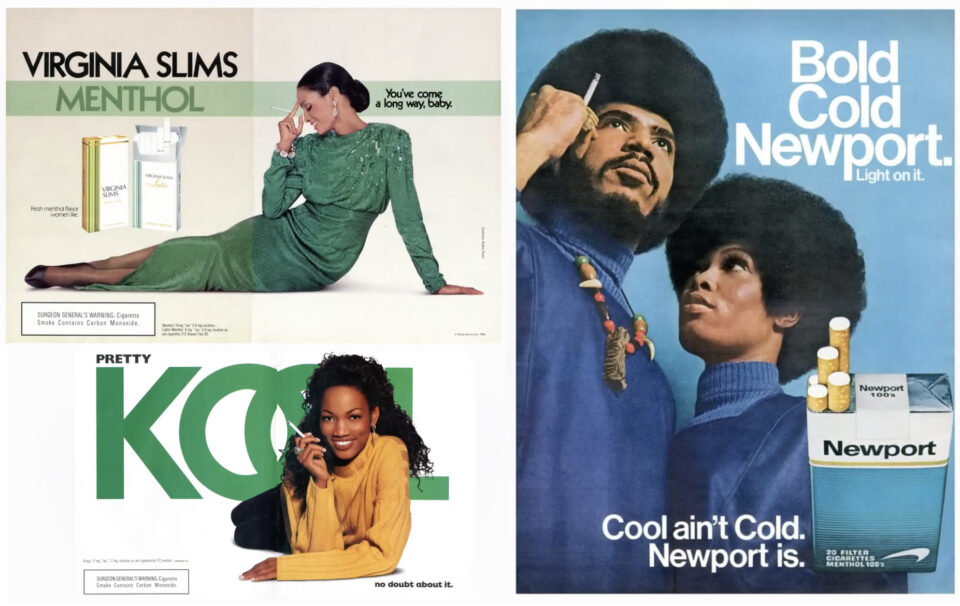
One big factor is socioeconomic status. In the United States, race is closely tied to class, with African Americans about twice as likely to be living in poverty. On average, education levels are lower as well. However, even among African Americans whose socioeconomic status is comparable to that of white people, despite higher education and more socioeconomic resources, health outcomes are still poorer. Part of that has to do with lifestyle behaviors. For example, fewer than 5% of African American adults met physical activity guidelines. Smoking rates are comparable, though African Americans tend to be exposed to more second-hand smoke and have lower quit rates. This may be because they’re more likely to use menthol cigarettes, which enhance nicotine’s addictive potential. Why menthols? Because tobacco companies’ marketing for mentholated products targets African Americans, as you can see in the ads below and at 2:43 in my video.
Black lives…Black lung.
Similarly, food messages on African American television shows reveal that not only does Black prime time contain more food commercials, but African American audiences may be receiving nearly three times as many ads for low-nutrient junk like candy and soda. That may be one reason why African Americans tend to consume fewer fruits and vegetables and are more likely to eat junkier foods. Of course, where are you going to get those fresh fruits and vegetables? There are fewer supermarkets in Black neighborhoods compared to white neighborhoods—as in, they have four times fewer supermarkets. What Black neighborhoods do excel in, though, is fast food. Predominantly Black neighborhoods have 60% more fast-food restaurants per square mile compared to predominantly white neighborhoods.
Now, of course, “dietary behaviors alone do not fully explain the significant differences in diet-related disease patterns between racial groups.” There are differences in employment, poverty, home ownership, and healthcare access, as you can see below and at 3:54 in my video.
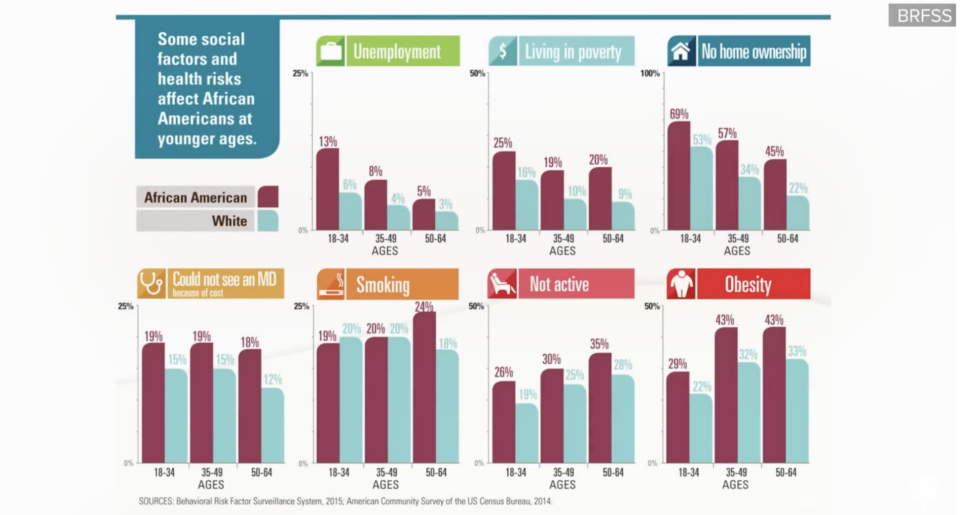
All of these factors can affect outcomes. But “[w]hile there are many social and economic factors such as racism and income inequality that contribute to health disparities, there is good evidence that simply eating a more plant-based diet could eliminate disparities in [cardiovascular disease] and diabetes.”
Here are the diabetes data. Even after controlling for education, income, physical activity, and Body Mass Index (BMI), non-Blacks eating strictly plant-based diets had 57% lower odds of diabetes. Among Black vegans, it was even more striking—70% lower odds. And that was after taking BMI into account. So, even at the same weight, Black vegans had 70% lower odds of diabetes than Black omnivores. The racial disparity is only about half that, at 36%. So, the increased risk of diabetes among Black participants was on the order of one-third, while the protection given by vegan diets in this subgroup was about 70%. Even just a vegetarian diet that includes dairy and eggs may more than counteract the racial disparity in diabetes risk.
And they are not the same weight. African Americans have higher obesity rates, cutting their lifespans by six years, but Black vegetarians and vegans have less than half the risk of obesity compared to those who eat meat. And this is after adjusting for differences in physical activity. So, even at the same exercise levels, those eating more plant-based had but a fraction of the obesity risk.
Then there is high blood pressure. In African Americans, hypertension is the most significant contributor to their increased cardiovascular disease burden and mortality. But Black vegetarians and vegans combined had 44% lower odds of hypertension, an important finding given hypertension is normally so prevalent in Black communities; no benefit was seen among those who cut out all other meat but continued to eat fish. The same thing was found for total cholesterol and LDL cholesterol: the odds were cut in half among Black vegetarians and vegans. “As with non-[B]lacks, these results suggest that there are sizeable advantages to a vegetarian diet in [B]lack individuals,” the researchers conclude.
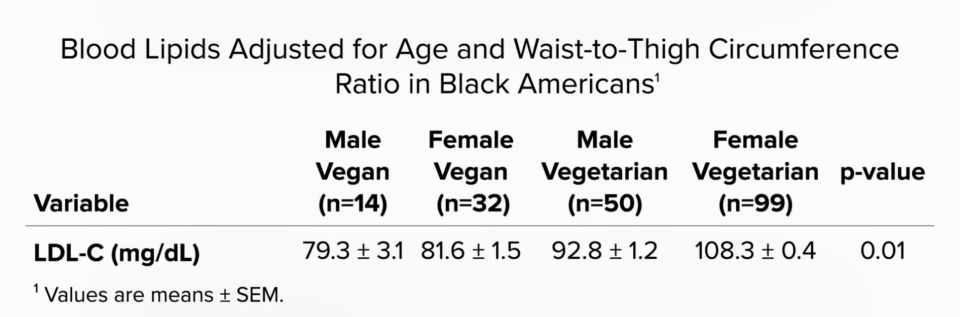
What happens when vegetarians are compared with vegans? The study’s title gives it away: “Cardiovascular Disease Risk Factors Are Lower in African-American Vegans Compared to Lacto-Ovo-Vegetarians.” This is something we’ve known about when Caucasian vegans have been compared to vegetarians. However, it was not known whether African American vegans had a more favorable cholesterol profile until this study. The results showed significantly lower LDL cholesterol in vegans. Now, of course, the vegans were also significantly slimmer, with an average weight in the normal range, compared to the overweight vegetarians. But even after taking that into account, those eating more plant-based had significantly lower cholesterol, as you can see below and at 7:11 in my video.
So, plant-based diets have tremendous potential to promote health among Black people in the United States. In fact, they may have an even greater benefit. For example, African Americans have an excess burden of chronic kidney disease, not only because they have more high blood pressure and diabetes, but also due to genetic factors. Between 8% and 12% of African Americans are carriers of the sickle cell trait, which places them at significantly higher risk of kidney disease. While Black people represent a relatively small fraction of the U.S. population, they account for more than a third of all patients on dialysis due to chronic kidney disease. And that’s where plant-based diets can come in, shown to protect against both the development and progression of chronic kidney disease.
Three-quarters of Black people are lactose-intolerant, too, so they would stand to benefit even more from eating a plant-based diet. “It is unacceptable that for decades, the American healthcare system has failed African Americans and other minority communities in both primary and secondary [cardiovascular disease] prevention,” but that just makes it all the more important for them to take the reins of their own health destiny.
Doctor’s Note
Food and tobacco aren’t the only products with marketing targeted at Black Americans. I previously covered the dangers of Johnson & Johnson’s talcum powder in Talcum Powder and Fibroids.
For more information on this topic, check out this webinar hosted by the Plantrician Project: https://plantricianproject.org/global-health-disparities-a-dialogue.
-
 HEALTH & WELLNESS8 years ago
Acidophilus: A Probiotic Bacterium
-

 herbs3 years ago
The Ultimate Guide to Ashwagandha Extract: Stress Relief and Optimal Health Unveiled
-
 HEALTH & WELLNESS7 years ago
Herbs and Essential Oils to Fight Coronavirus
-
 TRAINING & FITNESS8 years ago
6 Ways to Decrease your Shoulder Pain!
-
 Fitness8 years ago
“No Pain, No Gain” True or Just a Fitness Myth
-
 HEALTH & WELLNESS8 years ago
Why Muscles Get Sore
-
 DIET & NUTRITION8 years ago
Low Carb Diet: Carbohydrates Influence on Testosterone
-
 TRAINING & FITNESS7 years ago
Training to Failure Every Set… Pathway to New Muscle or Pathway to Overtraining?