
Uncategorized
Could Fasting Help Cancer Patients?

Could Fasting Help Cancer Patients?

What effect does supplemental feeding have on clinical outcomes?
In 1974, an influential paper was published decrying “physician-induced malnutrition” as “the skeleton in the hospital closet.” Many patients in hospitals were malnourished, which the editorial board of the Journal of the American Medical Association described as “shocking.” Even a single case is one too many, yet to this day the issue persists. If anything, people with serious illness would seem to need even more nutrition, not less, yet underfeeding remains common, involving as many as 50% of hospitalized patients. “The ethical principle of justice” requires that all patients be fed enough, given that hospital malnutrition has been associated with increased risk of disease and death. But is it cause and effect? Does eating less make you sicker, or does being sicker just make you eat less? You don’t know until you put it to the test. But would it be ethical to randomize patients to remain starved? Wouldn’t nutritional support obviously help? It turns out, no. Not one but 22 randomized controlled trials involving thousands of malnourished patients found that, sure, you can plump them up; however, there seems to be little effect on clinical outcomes. In fact, sometimes it can actually make things worse. Maybe the body is losing its appetite on purpose.
Ever since Hippocrates, fasting has been used to help treat acute and chronic diseases, based on the observation that when people get sick, they frequently lose their appetite. So, maybe that’s part of our body’s wisdom and we shouldn’t force it. But that was 2,400 years ago. What have we learned since?
Along with fever, decreased food consumption is indeed one of the most common signs of infection, “often regarded as an undesirable manifestation of sickness,” but it’s actually an active, beneficial defense mechanism. Obviously, chronic undernutrition can impair our defenses, but data suggest that in the short-term, immune function can be enhanced by lowering food intake. Some of the data are wild: In one study, after 48 hours of starvation, about 95% of mice survived an infection if they remained starved, while about 95% died if they were refed, as you can see below and at 2:27 in my video Fasting for Cancer: What About Cachexia?.
But that was in mice. Obviously, we can’t randomize people to a fatal infection, but the study showed that the blood from starved mice was nearly eight times better at killing off the invading bacteria in a petri dish, as you can see below and at 2:41 in my video.
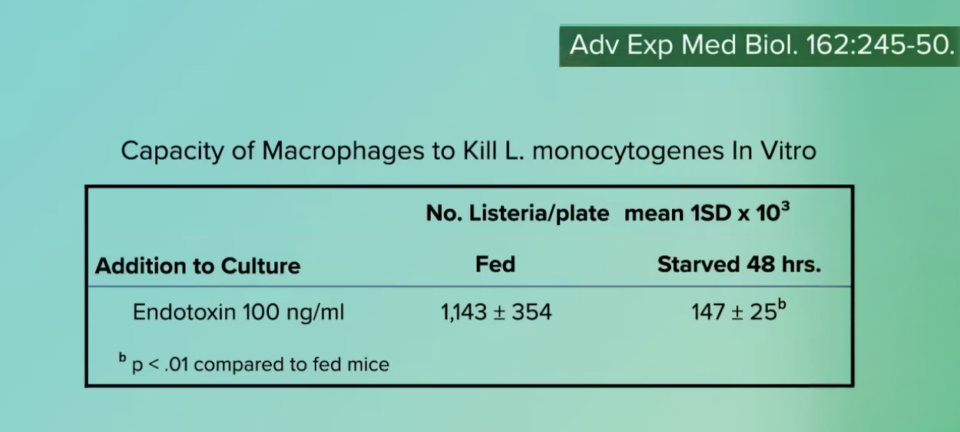
It dramatically boosted the capacity of their white blood cells to kill off the pathogens. Why can’t we just test people like that?
Indeed, we can. Researchers fasted people for two weeks on an 80-calorie-a-day diet, and their white blood cells showed the same kind of boost in bacteria-killing activity, a boost in antibody production, and a 24% average increase in natural killer cell activity. That’s especially interesting because our natural killer cells don’t just help clear infections; they also kill cancer cells. In fact, that’s how they measured natural killer cell activity—by pitting them against K562 cells, which are tumor cells (human leukemia cells). So, two weeks of fasting boosted their bloodstream’s ability to kill off cancer cells by 24%.
So, fasting is said to improve anticancer immunosurveillance—poetically described as “stimulating the appetite of the immune system for cancer.” So, why isn’t fasting used more to treat cancer? Until recently, fasting therapy has not been considered a treatment option, in part because a common therapeutic goal in palliative cancer care is to prevent weight loss and counteract the wasting syndrome known as cachexia, which is the ultimate cause of death in many cancer cases.
Tumors are voracious. They expand rapidly, needing lots of energy and protein, so cancer metabolically reprograms the body to start breaking down to feed them. It does this by triggering inflammation throughout the body. It’s not just that people lose their appetite. The key difference between weight loss from cancer cachexia and simple starvation is that cachexia cannot be reversed by feeding alone. Consider the case of a cancer patient whose weight started to drop. It’s no wonder—they were only taking in a few hundred calories a day. So, in addition to giving them about 100 grams of protein a day, researchers stuck a tube into a vein and infused up to 4,000 calories a day. But it didn’t matter. They continued to lose weight, as you can see at 4:56 in my video.
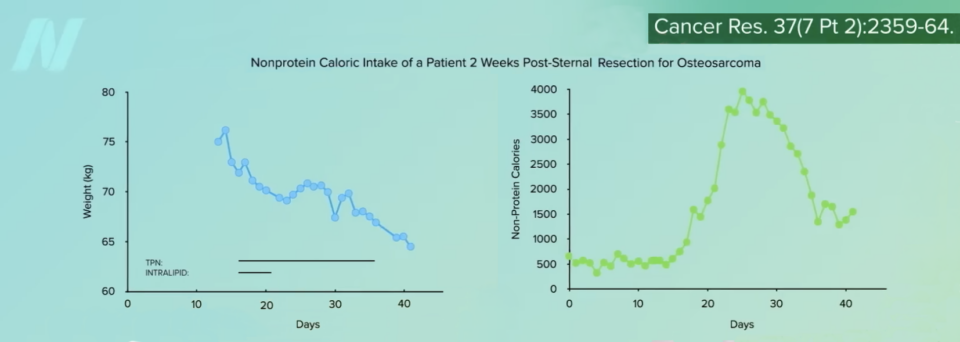
Attempts to correct or reverse cachexia through therapeutic nutritional interventions have had little success. The best treatment for cancer cachexia, therefore, is to treat the cause and cure the cancer. In fact, forcing extra nutrition on cancer patients could be playing right into the tumor’s hands. Like in pregnancy, when the fetus gets first dibs on nutrients even at the mother’s expense, the tumor may be first in the feeding line. Maybe the loss of appetite that occurs with cancer is actually a protective response. But in the 1960s, TPN—total parenteral nutrition—was born. People no longer had to eat; all the nutrition they needed could be infused straight into their veins, ushering in the modern era of nutrition support.
TPN became widely accepted and implemented, growing into a multibillion-dollar industry. Should it be routinely given to malnourished cancer patients? The answer’s not as obvious as one might think. When it was put to the test in dozens of randomized trials, “the results were both disappointing and surprising. Parenteral nutrition did not just fail to provide any benefit to these patients; it caused harm.” Not only did it appear to provide zero survival benefit, but there was also an increase in complications and infections, and a decrease in tumor response to chemotherapy, presumed to be due to all those extra nutrients stimulating tumor growth.
Similarly, trials of oral nutritional interventions, such as giving bottles of Ensure to malnourished patients with cancer, found no survival advantage. Despite the lack of demonstrated benefit, many oncologists’ knee-jerk reaction to the idea of cancer patients fasting is to worry that they’re not eating enough already. But you don’t know until you put it to the test, which we’ll explore in the next blog.
Doctor’s Note
This is part of an ongoing series about cancer and fasting. I previously laid the groundwork in these two blogs: Chemotherapy is Expensive—Is It Effective? and How Much Do New Chemotherapy Drugs Extend Life?.
Stay tuned for three more blogs on fasting and cancer:
What is the fasting-mimicking diet? I’ve got a video on that: The 5-2 Diet and the Fasting-Mimicking Diet Put to the Test.
All of my videos on fasting can be found on this topic page or in the recordings of my fasting webinar series.



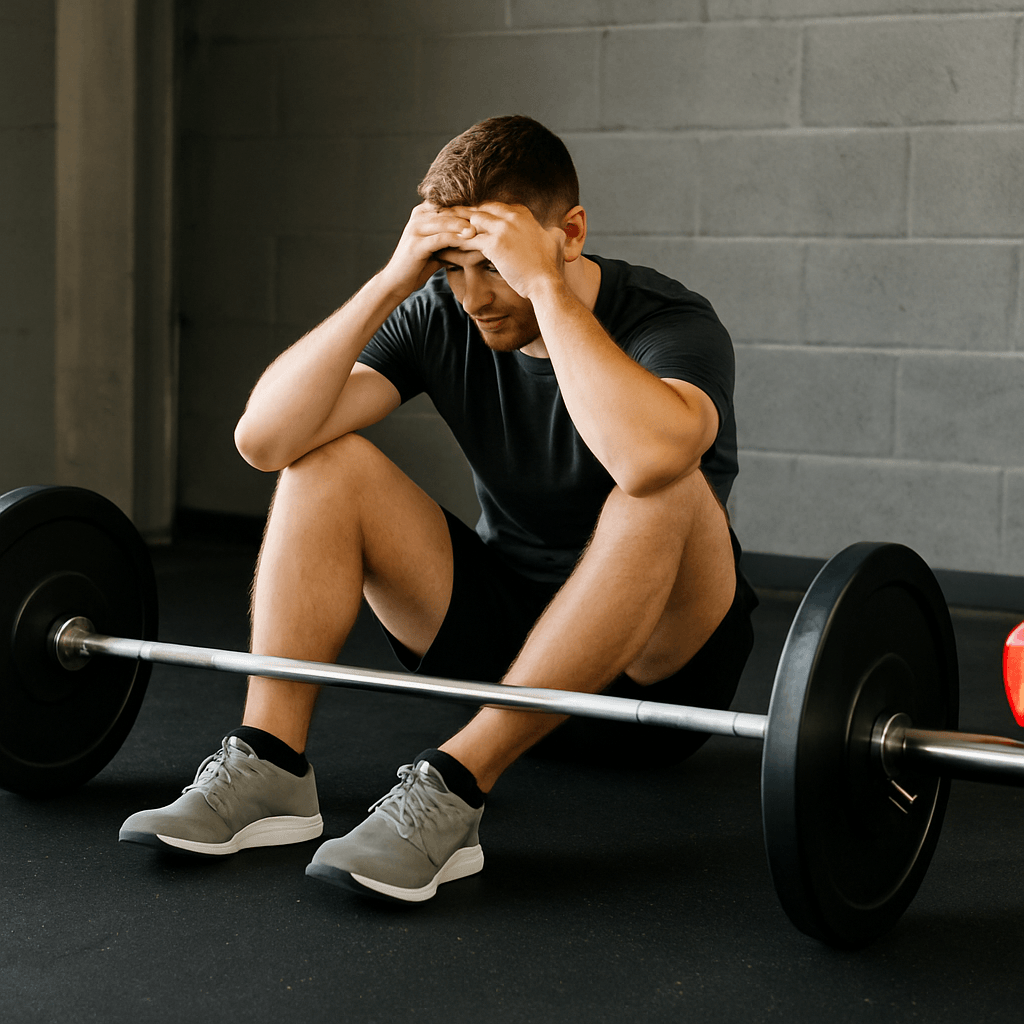
Feeling Stuck in Your Fitness Journey? Here’s the Fix
The first time I counted my macros, I think I lasted six hours.
I was 18 years old and bitten by the nutrition bug. I didn’t just want to go deep on being healthier — I wanted to be perfect.
Back then, there weren’t apps. Just online tools that now feel laughable by today’s standards. But I used those tools, studied every label, and weighed out my oats like a scientist trying to cure a disease.
By lunch, I was stressed. By dinner, I was doubting whether the banana I added to my protein shake needed to be logged in grams or slices. By 9 p.m., I was elbow-deep in wondering what time I had to wake up to drink protein and prevent catabolism.
This might sound like satire, but it was my life. And I was convinced this was the necessary path to better health, more muscle, and less fat.
Precision. Perfection. Pressure.
But the harder I tried to get it all “right,” the more I lost sight of the point.
I wasn’t trying to become a food tracker or a bodybuilder where the margin of error is so slight that indistinguishable changes determine winners and losers.
I was trying to become healthier. Ok, maybe I was trying to look good naked too. But I had no delusions about my goals. I was delusional about how many details I had to master to achieve them.
Why You Feel Stuck in Your Fitness Journey
If you’ve ever felt stuck in your fitness journey — like you’re trying hard but not making progress — you’re not alone.
Most people I meet who want to improve their health don’t fail because they’re lazy or undisciplined. They fail because they’re overwhelmed.
I won’t completely slam biohacking. If it helps you, great. I’m a bottom-line guy: if something helps you, even if I don’t believe in it, it did its job.
But biohacking specializes in fear, anxiety, and overthinking. It makes you stress every decision and uses complication to feign effectiveness.
They’re majoring in the minor.
Even people who don’t identify as biohackers fall into the trap of over-optimizing:
- Should I do fasted cardio or eat first?
- Is creatine OK if I’m not trying to bulk?
- Do I need eight hours of sleep, or can I get by on seven?
- Is oat milk inflammatory?
- How many reps are optimal for hypertrophy?
These questions do matter. But they don’t matter yet.
When you’re feeling stuck in your fitness journey, it’s often because you’re chasing the perfect plan instead of building the habit of showing up.
We overthink because we care. We want to do things the right way, the best way, the most efficient way. But overthinking is a clever form of resistance. It feels like work. It feels like progress. But it’s usually procrastination in disguise.
When you’re carrying the weight of trying to optimize everything, you stop moving. You doubt your decisions. You hesitate. And in the hesitation, you lose momentum.
It’s like standing at the edge of a pool debating the best angle to dive in — while everyone else is already doing laps.
Simplify First. Optimize Later.
So, what should you focus on?
Ask yourself: What’s the big thing I’m actually trying to do?
If your goal is to get stronger, then the most important thing is to show up and train at least 2 to 3 times per week and add a little more weight each workout. It’s not about choosing between 4 sets of 8 or 5 sets of 5. It’s about progression. If you’re not lifting more, then something is wrong. Strength is easy to measure. You either see it or you don’t.
If your goal is fat loss, then consistency with meals, portion control, and managing hunger will move the needle more than wondering whether your post-workout snack should be whey or casein. Many diets work. But if your body isn’t changing — if your clothes aren’t fitting differently, or the scale isn’t moving — it’s time to simplify.
If your goal is better health, then drinking more water, walking daily, managing stress, connecting with friends, and getting decent sleep will serve you better than chasing the best probiotic strain or taking out a loan for a full-body scan.
Don’t confuse detail with depth.
Trade Perfection for Progress
Instead of chasing perfection, ask what’s getting in the way of consistency.
- Is it decision fatigue at night that leads to overeating?
- A workout that’s too complex, so you skip it altogether?
- A nutrition plan that requires spreadsheets and measuring cups?
Simplify. Shrink the task. Choose the next obvious step, and do that.
Because no amount of health knowledge matters if it doesn’t lead to consistent action.
Your health doesn’t require precision. It requires permission — permission to not have all the answers before you begin.
So stop trying to get it all right.
You don’t need to earn your progress through struggle. You earn it by showing up again tomorrow.
Let that be enough.
Final Thought: What to Do When You’re Stuck
If you’re feeling stuck in your fitness journey, ask yourself: What’s one thing I can do today that’s easier than what I’ve been trying?
Start there.
Then keep going. Keep checking in on your progress. Ask how it feels. Ask whether it’s sustainable and repeatable.
If you’re seeing changes — in how you feel, how you look, or how you show up — then you’re on the right track.
And there’s no need to overthink it.
Adam Bornstein is a New York Times bestselling author and the author of You Can’t Screw This Up. He is the founder of Born Fitness, and the co-founder of Arnold’s Pump Club (with Arnold Schwarzenegger) and Pen Name Consulting. An award-winning writer and editor, Bornstein was previously the Chief Nutrition Officer for Ladder, the Fitness and Nutrition editor for Men’s Health, Editorial Director at LIVESTRONG.com, and a columnist for SHAPE, Men’s Fitness, and Muscle & Fitness. He’s also a nutrition and fitness advisor for LeBron James, Cindy Crawford, Lindsey Vonn, and Arnold Schwarzenegger. According to The Huffington Post, Bornstein is “one of the most inspiring sources in all of health and fitness.” His work has been featured in dozens of publications, including The New York Times, Fast Company, ESPN, and GQ, and he’s appeared on Good Morning America, The Today Show, and E! News.
Questified Nacho Bites | Quest Blog
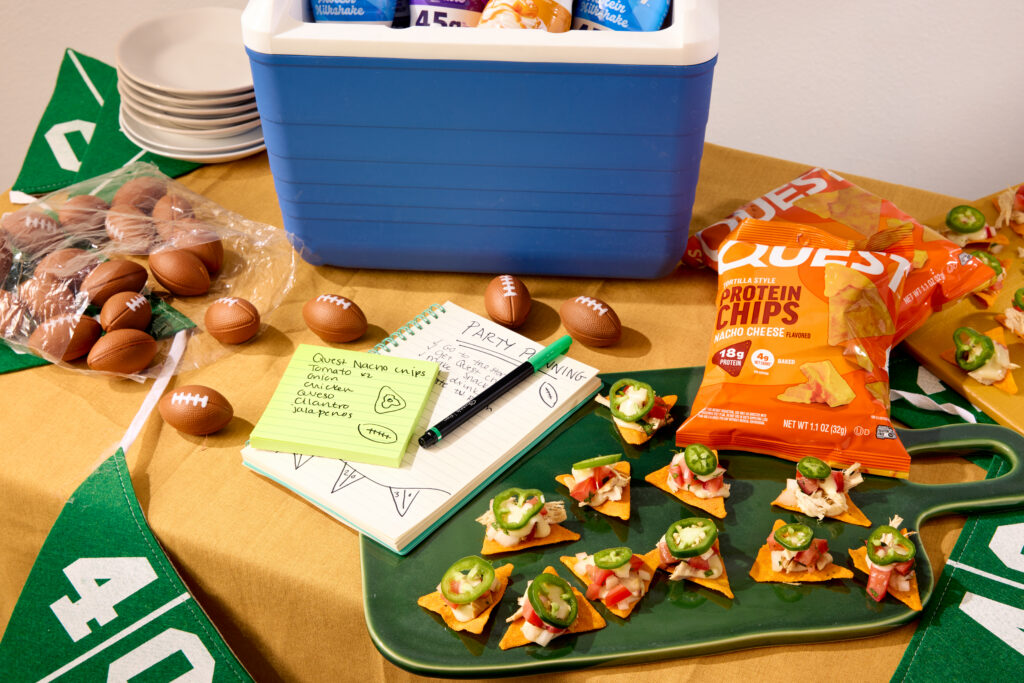
You packed the cooler, hauled the chairs, and are the reason the crew shows up hungry and leaves happy. So bring out the MVP: Questified Nacho Bites. Crunchy Quest Nacho Cheese Protein Chips loaded with fresh pico, shredded chicken, jalapeño, warm queso, all loaded with high quality protein. Feed the team and take your victory lap. You earned it.
Check out the full recipe below:
NUTRITIONAL INFO
QUEST NACHO BITES
Yields: 6 servings | Serving Size: 4 nacho bites
Calories: 110 | Protein: 13g | Fat: 4g | Net Carb: 4g
Total Carb: 5g | Sugar: 2g
Ingredients
QUEST NACHO BITES
- 2 bags Quest Nacho Cheese Tortilla Chips
- 1 roma tomato
- ¼ yellow onion (small)
- 1 tbsp chopped cilantro
- Squeeze of lime
- Salt and pepper to taste
- 1 jalapeno, thinly sliced
- 6oz shredded chicken breast
- ⅓ cup queso, warmed
Method
- Lay all the chips on flat on serving trays.
- Dice tomato and onion and place them into a small mixing bowl.
- Add in the cilantro, lime and salt and pepper and then combine.
- Place the queso into a pipping bag or spoon about 1 quarter teaspoon onto each chip, layer with pico de gallo, chicken breast, jalapeno and more queso.
- Serve.
Matt’s 30-Pound Sustainable Fat Loss Success Story
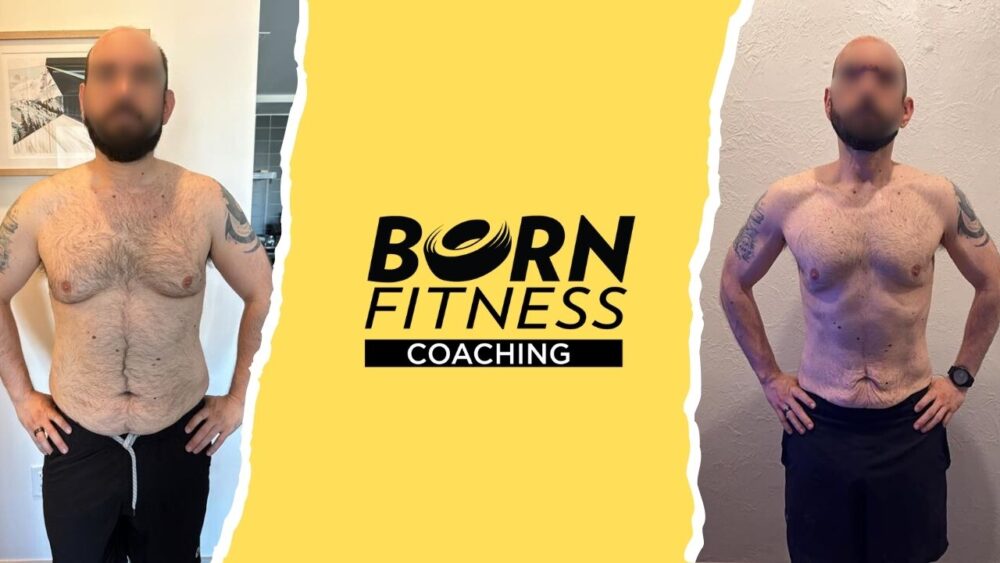
In less than a year, our client Matt lost 31.5 pounds and shrunk his waist by over 20 cm (nearly 8 inches).
But it wasn’t magic.
Sometimes it takes seeing yourself through a different lens to spark real change.
For Matt, that moment came during a Bali vacation in May. Looking at his photos, he knew something had to shift. With his 40th birthday on the horizon, he set an ambitious goal: to get into the best shape of his life.
“I’ve always been the guy who was in the gym,” Matt reflects. “Lifting with no real purpose and doing cardio—I called that a day.” But those vacation photos revealed a truth he couldn’t ignore. Despite his consistent gym presence, the results weren’t matching his efforts.
What Sparked Matt’s Sustainable Fat Loss Journey
Matt’s fitness journey began long before his Bali revelation.
At his heaviest in high school, he weighed nearly 300 pounds. By age 25, he’d lost 110 pounds and maintained a weight between 180-190 pounds. He even reached 168 pounds at one point, but as he describes it, he was “skinny fat”—the scale showed progress, but the mirror told a different story.
And despite his regular gym attendance, Matt’s workouts lacked structure. “I was your typical gym bro. Do Bis, Chest and Traps, and you’re good was my mindset.”
The frustration with plateaued progress set the stage for a change in approach—one that would finally align his efforts with his goals.
After interviewing several coaches, he found Born Fitness offered something different—a genuine investment in his success rather than treating him as just another client.
“I essentially did a Carrie Underwood and said, ‘Take the wheel!’” Matt recalls.
How Coaching Helped Matt Break Through His Fat Loss Plateau
One of the first things Matt committed to was tracking his food intake using MyFitnessPal.
We didn’t take a restrictive approach or eliminate entire food groups. Instead, the focus was on consistently hitting calorie and protein targets each day. That’s it. While you’ll likely need to adjust your calorie goals throughout the fat loss process, this simple approach helps you avoid overwhelm.
And rather than aiming for perfection, we emphasized awareness. For Matt, that meant getting a better sense of portion sizes and being more intentional with meals.
What about his workouts?
Matt came in with a classic “gym bro” approach—chest day, arm day, repeat. What he didn’t have was a structured, progressive plan.
We changed that.
Each 4-6 weeks, Matt followed a fresh training phase. Every plan was customized, but the consistent themes were:
- Full-body or upper lower split sessions 3–4x per week to train more muscle more often
- Progressive overload (increase weight, reps, or control over time)
- Conditioning finishers (sleds, circuits, intervals) to boost calorie burn without adding hours of cardio
This combination gave Matt the right amount of challenge without overtraining. He wasn’t left guessing what to do—and that structure freed him to focus on execution.
The result: For the first time, nutrition and training worked together, instead of against him. And that alignment unlocked progress he hadn’t seen in years.
As of June 2025, Matt’s results speak for themselves.
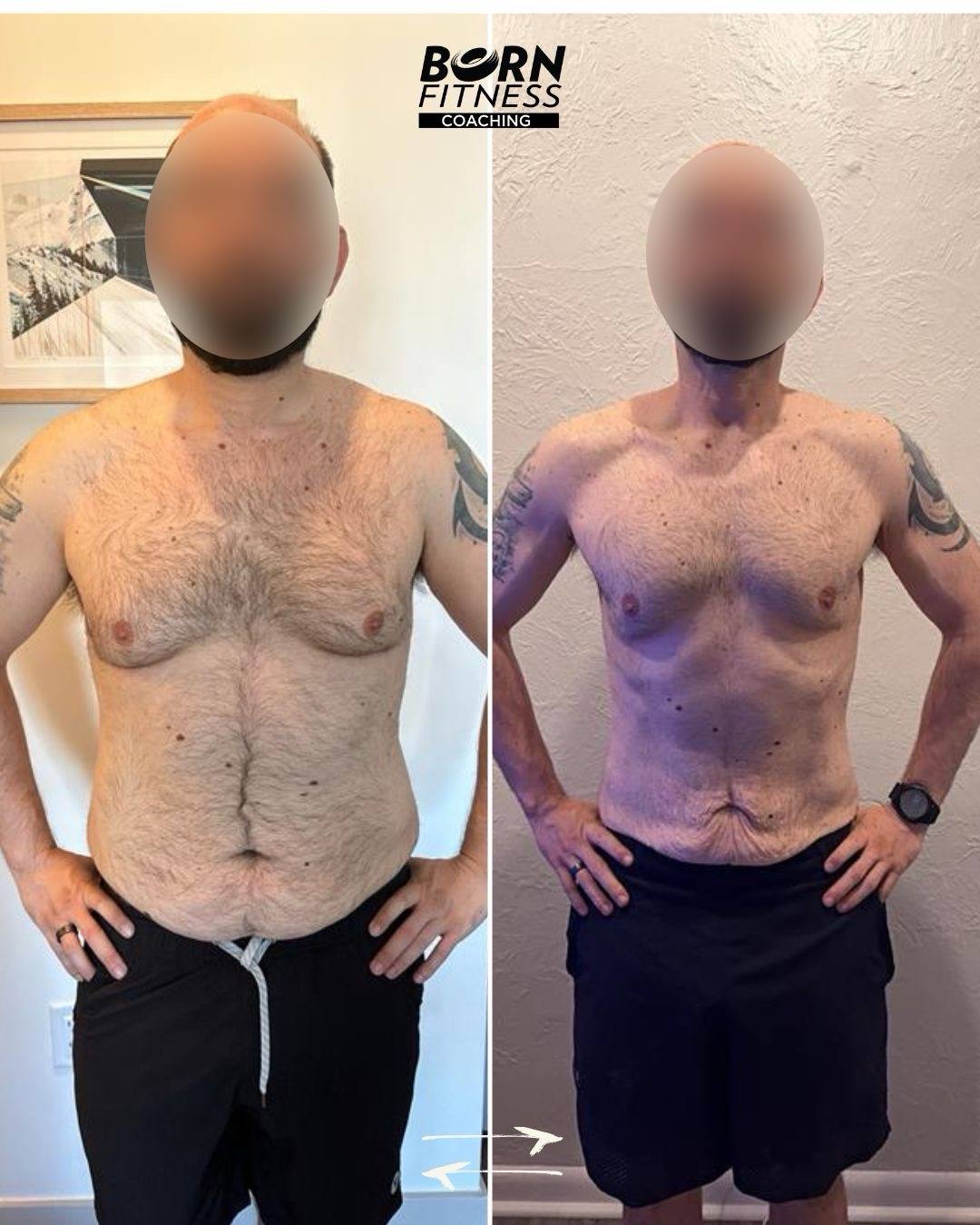
His weight dropped from 192.1 pounds to 160.6 pounds. His waist measurement decreased from 100.3 cm to 79.4 cm. That’s more than 30 pounds of fat loss and a full wardrobe transformation.
His strength skyrocketed—going from zero to three unassisted pull-ups and increasing his incline bench weights by over 60%.
But the numbers only tell part of Matt’s story.
For the first time, he’s shopping in the small size section—a milestone he never imagined possible. “I don’t say small in a way that means that I lost muscle. My strength has never been higher, but now clothes are fitting in ways that I never dreamed of.”
From Quick Fixes to Lasting Results
His relationship with food transformed too.
Instead of restrictive dieting, he learned to make smarter choices while still enjoying his favorites. “She doesn’t tell me to stop having Taco Bell,” Matt says about Coach Natalie, “but she would tell me ‘How can I make this healthier but still enjoy this?’”
This balanced approach has made his new lifestyle sustainable and enjoyable rather than feeling like a temporary fix.
On his 40th birthday, Matt sent this message:
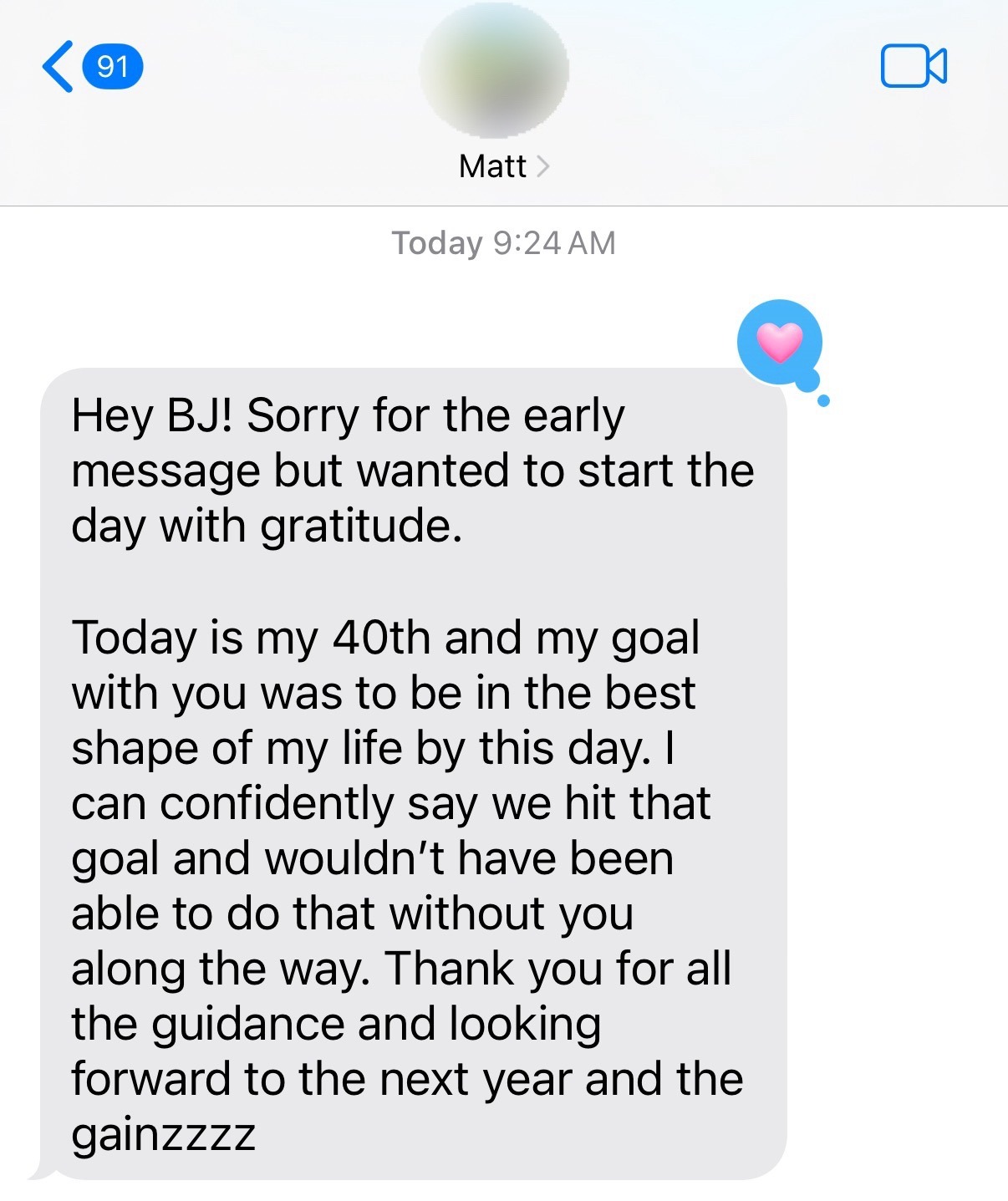
Matt’s transformation didn’t happen overnight—but it happened because he stopped winging it and found a plan that worked for him.
If you’re stuck trying to do this on your own and want the kind of structure and support Matt found, our coaching might be a fit for you.

B.J. holds a B.S. in Health and Human Performance and multiple certifications, including Precision Nutrition Level 1 and BioForce Certified Conditioning Coach. Over his 14-year coaching career, he’s been fortunate enough to coach a wide range of clients. From online clients looking to get in great shape to CEO Nate Checketts (Rhone) and CEO Marcelo Claure (Softbank), and professional skateboarder Sean Malto. Before beginning his training career, he was a sports science lab research assistant.
-
 HEALTH & WELLNESS8 years ago
Acidophilus: A Probiotic Bacterium
-

 herbs3 years ago
The Ultimate Guide to Ashwagandha Extract: Stress Relief and Optimal Health Unveiled
-
 HEALTH & WELLNESS7 years ago
Herbs and Essential Oils to Fight Coronavirus
-
 TRAINING & FITNESS8 years ago
6 Ways to Decrease your Shoulder Pain!
-
 Fitness8 years ago
“No Pain, No Gain” True or Just a Fitness Myth
-
 HEALTH & WELLNESS8 years ago
Why Muscles Get Sore
-
 DIET & NUTRITION8 years ago
Low Carb Diet: Carbohydrates Influence on Testosterone
-
 TRAINING & FITNESS7 years ago
Training to Failure Every Set… Pathway to New Muscle or Pathway to Overtraining?